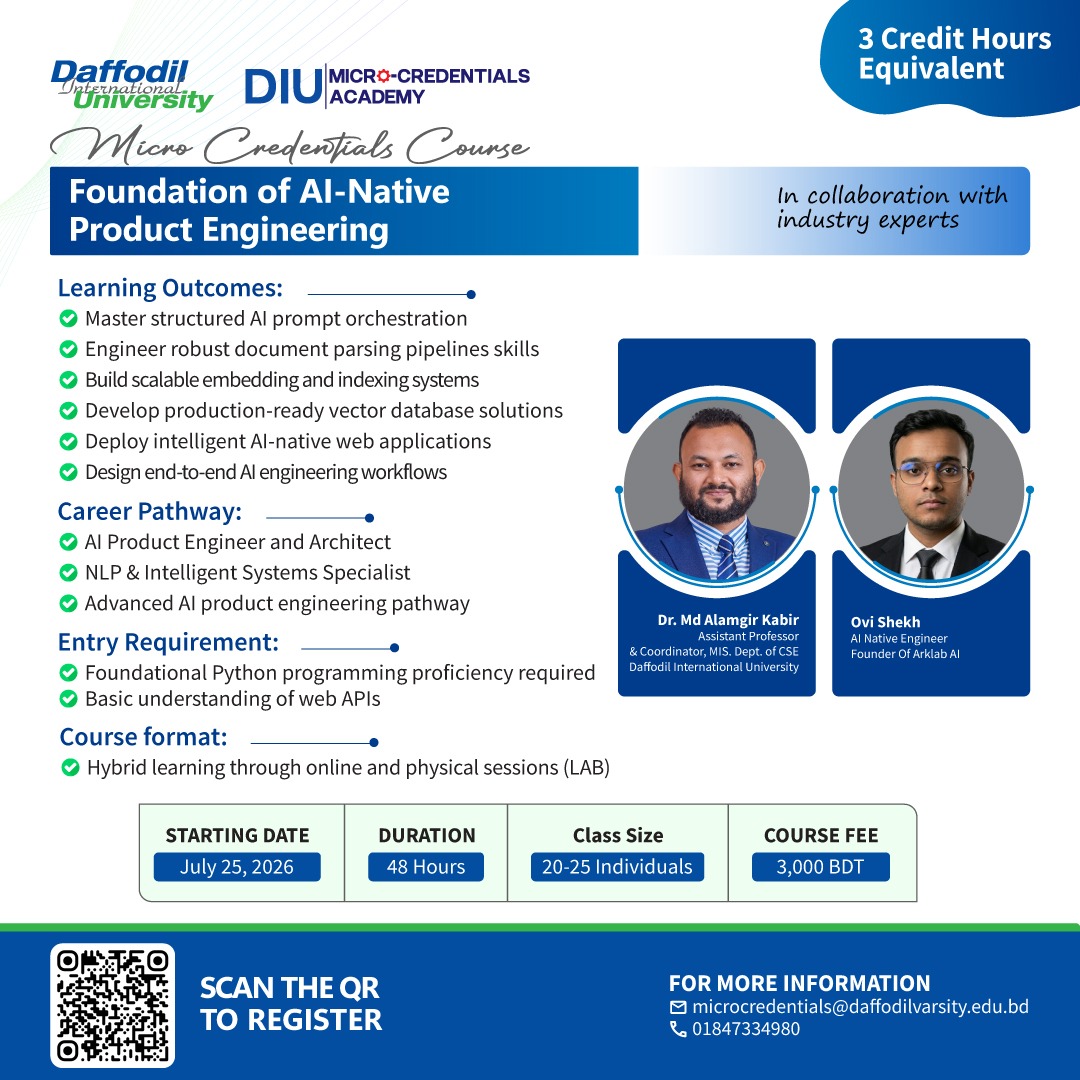
Foundation of AI-Native Product Engineering
A certified 48-hour program to transform developers into AI engineers — by Daffodil International University & Arklab AI.
Duration
48 Contact Hours
Seats
Max 20-25 seats
Level
Beginner to Advanced
Mode
Hybrid : Lab + Online
About This Course
This foundational course transforms traditional deterministic software developers into AI engineers. It provides hands-on fluency in prompt orchestration pipelines, context-window token management, and localized data retrieval architectures. Learners move beyond basic AI chat interfaces to programmatically engineer stable, predictable software systems that interface securely with Large Language Models.
What You'll Learn
Meet Your Instructors
Dr. Md Alamgir Kabir
Assistant Professor & MIS Coordinator · Dept. of CSE
Daffodil International University — course academic lead and curriculum designer.
Ovi Shekh
AI-Native Engineer · Founder, Arklab AI
National AI Olympiad 2025 winner. Two startup exits. Builds AI products for clients across Bangladesh, the US, and Southeast Asia.
Curriculum
9 hands-on lab modules across 48 contact hours.
AI-First Thinking & Context Mechanics
Lab 1Hands-on evaluation of context window limits, token calculation debugging, and tracking API runtime latencies.
AI-Native Product Idea Generation
Lab 2Evaluating deterministic software boundaries vs. probabilistic AI-first product opportunities; mapping real-world problems to functional AI ideas.
Prompt Engineering with Tools & Functions
Lab 3Writing, testing, and versioning system prompts; configuring explicit function-calling architectures for predictable JSON outputs.
Scraping & Parsing (AI-Ready Data Platform)
Lab 4Writing data ingestion scripts to scrape text and parse unstructured files (PDFs, Markdown); implementing semantic document chunking.
RAG Models (AI-Ready Data Platform)
Lab 5Initializing/managing open-source local vector databases (ChromaDB); generating text embeddings and implementing vector similarity search.
Visualization & Presentation
Lab 6Designing clean user interfaces to expose semantic data metrics, retrieval histories, and model outputs.
Capstone — Idea to Pitch Deck
Lab 7Consolidating validated product concepts into technical pitch decks and presenting architectural blueprints.
Building a PRD & Master Build Prompt
Lab 8Writing a technical Product Requirement Document (PRD) mapped to AI system behaviors and translating it into an immutable master prompt stack.
AI-Native Tools for Scalable Applications
Lab 9Orchestrating components into an end-to-end web application using Streamlit or Gradio and deploying a live sandbox.
Learning Outcomes
Enforce strict JSON object structures on LLM inference loops to guarantee software API stability
Develop and deploy a working data parsing, embedding generation, and metadata indexing code routine
Initialize, build, query, and maintain localized vector database arrays (ChromaDB)
Package and run an interactive, data-grounded AI-native application via Streamlit or Gradio
Frequently Asked Questions
Ready to become an AI Engineer?
Seats are limited to 25–30 participants. Secure your spot before enrollment closes.