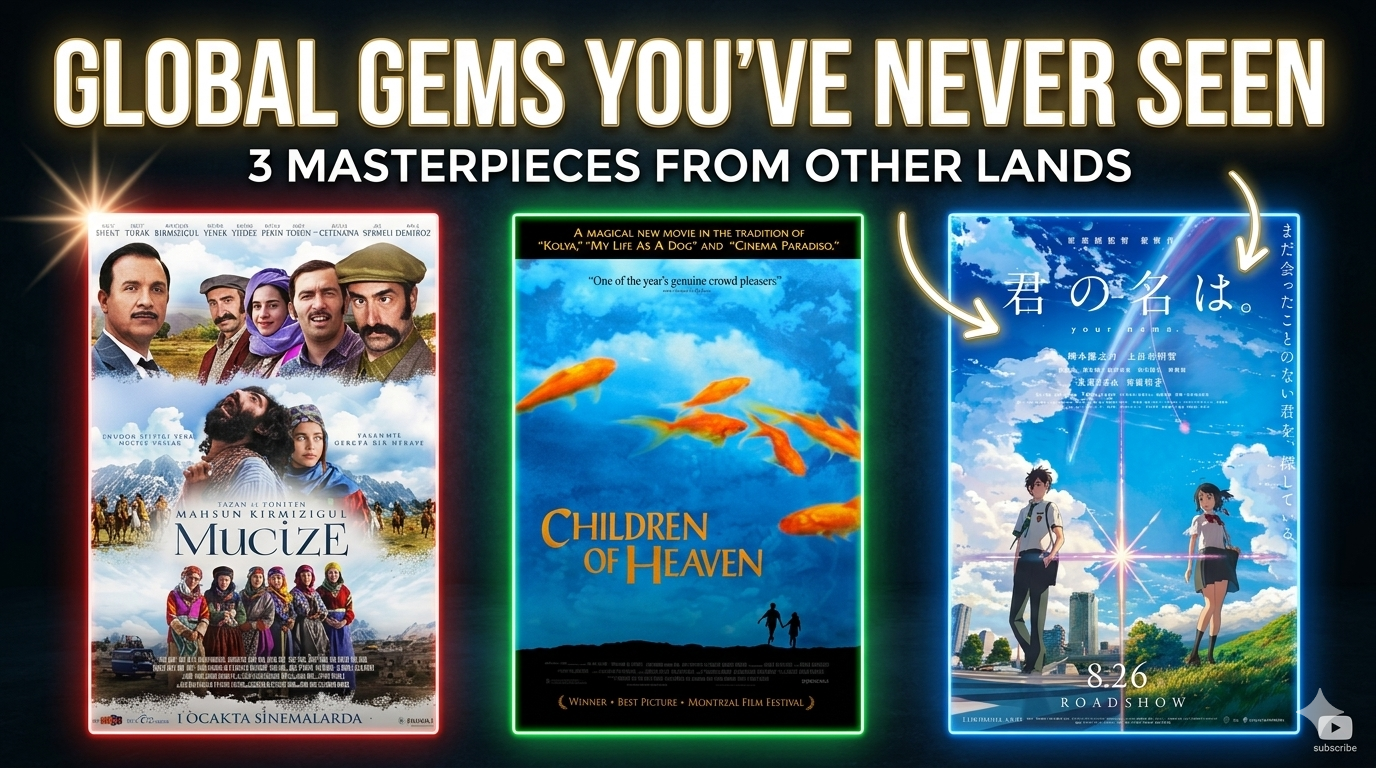

I don't talk about films much publicly. But these three - a Turkish Movie, an Iranian gem, and a Japanese anime - hit me in a way that most Hollywood blockbusters never have.
They are quiet films. Honest films. The kind that don't need explosions or plot twists to wreck you. They just show you something real and let you feel it.
Here's everything you need to know before (or after) watching each one.
1. The Miracle (Mucize) - Turkey, 2015
Director: Mahsun Kırmızıgül
Language: Turkish
Genre: Drama, Romance
IMDb Rating: 8.3/10
The Plot
Set in a remote, snow-covered village in eastern Anatolia in the 1960s, The Miracle follows Aziz, a young man with a physical disability who is assigned as the new teacher of a tiny village school that has never had an educated instructor before.
The villagers are deeply suspicious of outsiders and initially resist Aziz - not just because he is from the city, but because of his disability. They cannot imagine what someone like him could possibly offer their children.
But Aziz does not give up. He builds trust slowly, lesson by lesson, day by day. He teaches the children not just literacy and mathematics, but opens their world to ideas they had never encountered. Along the way, he falls deeply in love with a woman from the village - a love story that becomes the quiet heartbeat running beneath the whole film.
The story builds toward a singular, pivotal moment: the village needs a road. Building it would connect them to the modern world and save lives during harsh winters. Aziz fights for it with everything he has - writing letters, making calls, advocating - all while navigating the rigid, traditional hierarchies of rural Turkish society.
Why I Love It
When Aziz faces his father - who does not believe in him, who has never believed a disabled man could live a full and dignified life - and says with complete conviction:
"No, Father. I have fallen in love with my wife."
That single line carried the weight of his entire journey. It wasn't defiance for the sake of it. It was a man who had built a life from scratch, who had earned love, community, and respect, and who was simply stating a fact. It made me happy in a way that's hard to explain. Full, somehow.
2. Children of Heaven (Bačče-hā-ye āsmān) - Iran, 1997
Director: Majid Majidi
Language: Persian (Farsi)
Genre: Family Drama
Awards: Academy Award nominee for Best Foreign Language Film, Winner - Montreal World Film Festival
The Plot
In a working-class neighbourhood of Tehran, a young boy named Ali accidentally loses his little sister Zahra's shoes - the only pair she owns. Too afraid to tell his struggling parents, who are barely making ends meet and cannot afford another pair, Ali and Zahra hatch a secret plan: they will share Ali's tattered sneakers, swapping them between school shifts each day so neither of them misses class.
What follows is the most tender logistical problem you will ever see on screen. Zahra rushes out of her school the moment class ends, kicks off Ali's shoes, and Ali sprints barefoot until he reaches her, slips them on, and races to school before the gates close. It becomes a daily ritual of love disguised as survival.
The film builds to a city-wide running race, where Ali discovers the third-place prize is a pair of shoes. He doesn't want first place. He doesn't care about the gold medal. He just wants third - a single pair of shoes - so Zahra won't have to run anymore.
But in a film about small children and shared shoes, Majid Majidi somehow shows you everything about dignity, sacrifice, and what it means to love someone quietly, without fanfare, without anyone even knowing.
Why I Love It
There is a moment near the end, when Ali is sitting with his feet in a small fountain in his courtyard - his feet bleeding and blistered from the race he pushed himself through - and the goldfish in the water swim around his ankles as if to comfort him.
He didn't win third place. He won first. And he is devastated.
Not because he wanted a trophy. Because his sister is still waiting for shoes.
That moment is not dramatic. There is no music swelling. No speech. Just a boy, a fountain, and goldfish. And it broke me completely - because it understood something most films don't: the purest kind of love is the kind no one sees. The kind that runs barefoot so someone else doesn't have to.
3. Your Name (Kimi no Na wa) - Japan, 2016
Director: Makoto Shinkai
Language: Japanese
Genre: Animated, Romantic Fantasy
Box Office: $380 million worldwide - highest-grossing anime film at the time of release
The Plot
Mitsuha is a teenage girl living in a small rural mountain town in Japan. She dreams, desperately, of living in Tokyo - the city lights, the noise, the anonymity. Taki is a teenage boy in Tokyo, busy with school, part-time work, and the vague restlessness of not knowing what he wants from life.
One day, they begin waking up inside each other's bodies.
It happens randomly, without explanation. They leave each other notes in phone journals, trying to navigate the chaos of inhabiting someone else's life - Mitsuha dealing with Tokyo, Taki figuring out life in a town he's never been to. Slowly, through these notes, through the choices they make inside each other's lives, they begin to know each other. To care about each other.
Then the switching stops. And Taki realizes something has gone terribly wrong. He tries to find her - travels to her village - and discovers it no longer exists. A comet struck three years earlier. Mitsuha's town is gone.
What follows is a race across time, memory, and twilight - driven by a thread of connection so thin it barely exists, but strong enough that neither of them can let go.
The film asks: What if you loved someone you've never actually met? What if that love was written somewhere deeper than memory - somewhere in the body itself?
Why I Love It
I had always admired Makoto Shinkai's work - his films have a way of making the ordinary look sacred. But Your Name took me somewhere else entirely.
There is a moment on a staircase, at twilight, when Taki and Mitsuha almost find each other across time. Their hands reach. Their names are on the edge of their tongues. And then - the light changes, and they forget.
They forget each other's names. They forget everything. But they are left with the feeling. That hollow ache of missing someone you can't remember.
If love ever knocks at my door, I want it to feel like that - like something that existed before I understood it, something I'd search for even without knowing what I was looking for.
(Without the body-swapping and the comet, obviously.)
Why World Cinema Matters
Hollywood is a language. A very loud, very confident, very specific language.
But these three films - Turkish, Iranian, Japanese - each spoke in a register I didn't know I was waiting to hear. They assumed I could handle quiet. They assumed I could sit with uncertainty and feel it. They didn't over-explain. They didn't resolve everything neatly.
They just showed me people living fully, loving imperfectly, and reaching for something they may never reach - and somehow that was enough.
If you haven't seen any of these, pick one tonight. Start with Children of Heaven if you want something short and devastating. Start with Your Name if you want to be transported. Start with The Miracle if you want to be reminded that a single life, lived with dignity, can move mountains.
These are my personal favourites - films I return to in my mind even when I'm not watching them. If you've seen any of these, I'd love to know what stayed with you.